

“So, when do you think you might retire?” That question on multiple occasions has been asked of my wife and I in the past several years. It’s an understandable question. After Forty-nine years of full-time vocational Christan ministry my wife and I are no longer spring chickens. Our ministry opportunities have spanned all six inhabited continents with U.S. mission outreaches from the East coast to the West coast. We’re now at an age when many of our contemporaries have cashed in their chips and are now playing golf, traveling the world or hanging out with their grandkids.
“Retire?” My wife responds incredulously. “This isn’t a job; this is my life.” Work is not about accumulating money so that I can eventually do what I want to do. Work is what God has created you and me to do. But how we view work determines the degree we maximize our impact for Christ!
TWO COMPETING CHRISTIAN WORLDVIEWS
View #1 – The secular and sacred divide.

View #2 – Two opposing kingdoms. These kingdoms are at war with one another. There is the kingdom of Satan and the kingdom of God. Let’s define both views.


Secular relates to worldly things or things that are not regarded as religious, spiritual, or sacred. They are viewed as temporal. Therefore, they have temporal values.
Sacred relates to religion. It is connected to a deity and has some religious purpose. Therefore, they have eternal value and should be sought over secular pursuits.
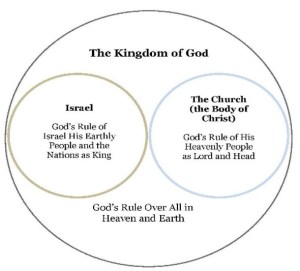
The kingdom of God is the rule of God, whether over nations and kings or the human heart and the body of Christ.
The kingdom of Satan is the rule of Satan over our world. Adam and Eve sinned. God gave their rulership over the world to Satan. Satan now temporarily rules over the affairs of man. He does so under the authority of God.
This first worldview looks at our world from the perspective that there is a secular realm and a sacred realm. The secular realm includes such venues as family, politics, business, art, education, etc. It is the place where most people live their everyday life. Yes, they go to church and may be involved in various activities, but they are only giving their leftover time. When they compare the percentage of their week that was working in the secular compared to the percentage working in the sacred, it is obvious who is more committed. They know the sacred or spiritual realm is where people who are fully committed go to serve God.
The Two Kingdom Worldview
The second worldview holds no distinction between the secular and sacred realms. Instead, they believe the world is where an ongoing battle rages between the Kingdom of Satan and the Kingdom of God. Those aligned with Satan (whether intentionally or not) reject God’s rule. Therefore, as a Christian, it only matters that you serve Christ and His Kingdom, not Satan’s. The issue is not where you work but who you serve. Those who reject Christ serve Satan. Those who submit to Christ serve God and seek to build His kingdom.
The battle between God and Satan knows no bounds. Whether inside or outside the church, there is a battle. The issue is whose side are you on, God’s or Satan’s?
Whether a Christian works in the church or one of the other domains (e.g., politics, business, the arts, or education), selecting either domain is an equally valid spiritual choice when made by faith. The battle is not over what vocational choice a person makes but over who they serve in their vocational choice.
CONSEQUENCES FOR EACH WORLDVIEW
What’s the problem with the secular-sacred worldview?
The secular-sacred view makes an artificial dichotomy—it pits those who serve in a “spiritual arena” against those who work in a “secular arena.” As a result, there become two classes of people: the haves (those Christians who have embraced God’s best as evidenced by choosing to serve God full-time, what we call sacred) and the have-nots (those Christians who have settled to work in a secular job; thus, settling for second best). Rather than uniting the body of Christ, this perspective divides people. This view creates divides between Christians. This artificial (non-biblical) divide produces an improper view among Christians.
It plays into Satan’s hands and is an effective strategy to immobilize most Christians from ministry involvement. If you can keep most Christians out of the fight (i.e., those people in the secular work world), then Satan can minimize the impact of Christ on the world.
Why the Two Kingdom Worldview Reflects God’s Heart
The two kingdoms’ perspective views every Christian as a lifetime laborer. Whether a person joins a church, becomes a full-time ministry staff member in a church or a parachurch organization, goes into the marketplace, or chooses to be a stay-at-home mom, each of these choices is potentially a kingdom-building enterprise and worthy pursuit. If their motives are right, every Christian should be engaged in the battle in their context; there are no exceptions.
The issue is not geography (where you go to work) but whether you are engaged in the battle in your chosen place of work. For example, you can work in a church and not be in this battle against Satan to extend God’s kingdom. Or you can work as a janitor and be engaged in this battle. How? When a janitor fights against Satan’s schemes or systems (see Eph. 2:2; 6:10-12) and seeks to extend God’s kingdom, he is in this battle. Or when a dad and mom fight for their children and train them in the Bible and the walk of faith, they have entered this battle. (1)
WHATEVER YOUR WORK IS YOUR CALLING
This is why Colossians 3:23 says, “Whatever you do, work at it with all your heart, as working for the Lord.” And, in 1 Corinthians 10:31: “So whether you eat or drink or whatever you do, do it all for the glory of God.”
Yes, at some point, Lorna and I will retire from our full-time vocational work. But we won’t retire from the work Christ gave us. Because you see, our call was never to the mission organization we have worked with for nearly a half century.
Our calling (our real work) is the same as it is for every follower of Christ. No matter what your vocation and no matter your age, if you have breath it remains the same.
Our calling is to be a disciple of Christ (a Christ-follower) by loving God and loving others as we point them to Jesus through our words and lifestyle. Each person has a different personality, different gifts, abilities, strengths and weaknesses. God opens different opportunities in different seasons to do a whole variety of different vocational pursuits. But every opportunity places His Christ-followers around people that God has called us to influence for Him.
We serve a God who has created a diverse world with diverse people that requires diverse vocational pursuits. Jesus has made God’s marching orders clear for every believer. Every follower of Christ is a missionary (a sent one). Jesus says in Matthew 5:14-16, 14 “You are the light of the world. A town built on a hill cannot be hidden. 15 Neither do people light a lamp and put it under a bowl. . . 16 In the same way, let your light shine before others, so that they may see your good deeds and glorify your Father in heaven.
Notice, these words by Jesus were not directed to his selected disciples, it was given at the Sermon on the Mount. It is what Jesus expects of every Kingdom follower. It is your calling and mine. The question isn’t what my vocation should be? Instead, the question is where can I live out my calling to the best of my ability. And for most people, our vocations will change over time, but our calling never will.
Are you letting your light shine wherever you are and whoever you are with and at whatever your age? That’s your work and calling! Watch this 3 minute video clip on a biblical perspective of work: “How Then Should We Work”
(1) This content (the two competing worldviews) has been adapted from the Master’s degree curriculum, “Maximizing Kingdom Impact” created by the School of Applied Leadership for Transformation (SALT).
 Dirke Johnson has a doctorate in Church Leadership and has been a professor for the Ministry Degree program at Palm Beach Atlantic University. Currently he is an Associate Faculty for Kairos University and he works with Cru’s Global Leader Strategies as the director of the Doctor of Ministry program for the School of Applied Leadership for Transformation (SALT). He specializes in Leader Development with years of experience at ministering in urban cross-cultural and international contexts.


Dirke,
God’s timing is uncanny. Yesterday, I attended the funeral of my friend/coworker/boss who was also a counselor. She wrote the most beautiful email to the staff when she entered Hospice care (she died of cancer). In her message, she stated that she “loved the sacred work of therapy.” I was able to speak with her at length a couple of weeks before she passed (such a blessing!) and we discussed her use of the word “sacred.” We talked about how evident it was that our Transcendent God worked through us in those hours spent with people who are made in God’s image, that in spite of our practice being “secular,” we had seen the Spirit of God transforming lives. Often, clients will share how they have grown closer to God, or started a relationship with Jesus. Then the floodgates open! We are able to get deeper healing, full growth through therapy.
Anyhow, couldn’t agree with you more; “every opportunity places [God’s] Christ-followers around people that God has called us to influence for Him.” Grateful to continue to serve God in my vocation at the ripe age of 61–and beyond! Sending love to you and Lorna.
LikeLike
Thanks Cyndi for sharing. It sounds like your friend was doing God’s work in significant ways with those she served. I’m glad she was able to grace you with that conversation. Tell Scott hi from Dirke & Lorna!
LikeLike