

for Christ-followers!
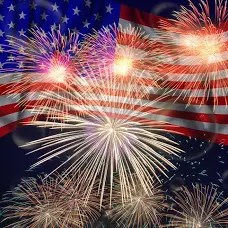
On July 4th, all across America fireworks will be shooting off, picnics and family gatherings will be celebrating America, “the land of the free and the home of the brave.” We acknowledge what our forefathers fought for and the adoption of the Declaration of Independence on July 4th, 1776, which declared the original colonies to be free from British rule. However, it wasn’t until 1783 when America actually was free from British rule and the American Revolution came to an end.
The vote by the 2nd Continental Congress (which formed after the start of the Revolutionary War in 1775) was taken on July 2nd. That vote prompted John Adams to write to his wife, Abigail:
The second day of July 1776, will be the most memorable epoch in the history of America. I am apt to believe that it will be celebrated by succeeding generations as the great anniversary festival. It ought to be commemorated as the day of deliverance, by solemn acts of devotion to God Almighty. It ought to be solemnized with pomp and parade, with shows, games, sports, guns, bells, bonfires, and illuminations, from one end of this continent to the other, from this time forward forever more.
How true John Adams was in so many ways. It certainly has become a National Day of Celebration. And, rightfully so. There are many things that we can be proud of for our country and its accomplishments. Almost all countries have an independence or liberation day. I counted 178 countries with such a day and I most likely missed a few in my tabulation. All of them have reason to be proud. But, like all nations, there are things that we are not so proud of and wish were different.
The United States may have gained its independence on July 4th, 1776, but it wasn’t until June 19th, 1865, that true liberation was felt within the United States of America by all. On this day, the last enslaved people gained their freedom after federal troops arrived in Texas to enforce the decree that all slaves be freed. That day is now known as Juneteenth. That day is a symbol of liberation and freedom for all.
As significant as the 4th of July and Juneteenth is in recognizing independence and freedom, there is a much greater and more significant Independence Day!
Every nation’s liberation day pales in comparison. For every nation, as great as they may see themselves, and wish to be, when honest at their core, must acknowledge their ongoing human dependence and enslavement to self-centeredness. A proclivity for selfish ambition and greed. A natural tendency to enforce laws that protect some more than others; that benefit some more than others; to favor the “have’s” more than the “have-not’s.” It is a common thread in all countries that the complaints of some are heard and others are ignored. Wealth and riches are the holy grail in pursuit of personal happiness. Some countries may be better than others, but all are plagued with the same weaknesses and frailties.
As great as our human nations are, they all fall woefully short of a greater spiritual nation that demands a greater allegiance and humble submission of worship. John Adams alluded to this in his letter to his wife when he said this day of deliverance “should be commemorated by a solemn act of devotion to God.” Such a statement acknowledges that the devotion to almighty God stands above any human liberation, any creation of a human nation. Adams is not equating America as some are prone to do as to being God’s favored nation above all other nations. What Adams is acknowledging is for America to arrive at this place of independence in 1776 is an act of God and therefore God needs to be given devotion. This same sentiment should be said of all 178 nations who cheer on their day of liberation.
What is the greater Independence Day? The apostle Peter speaking to those who have said yes to Christ and the forgiveness God offered through Jesus’ sacrificial death, says in 1 Peter 2:9: “You are a chosen race, a royal priesthood, a holy nation, a people for God’s possession, so that you proclaim the excellencies of God.”
 What is this holy nation that Peter is referring to? The New Testament calls it “The Church.” In the Greek it is called the “ekklesia.” The church is not referring to a location of brick and mortar. It is not referring to a denomination like Catholic, Baptist, Presbyterian, etc. or to those who may be on the membership role of such human religious institutions. It is referring to the invisible and universal community of followers of Christ who are in both heaven and on earth. They are sometimes referred to as the “Community of the Redeemed.” They have been redeemed not by their good intentions or good deeds, but by the blood of Christ shed for them. They are not perfect, far from it, but the true “Ekklesia” is made up of true followers of Christ who proclaim:
“Jesus is Lord,” and believe in your heart that God raised him from the dead . . . 10 For it is with your heart that you believe and are justified, and it is with your mouth that you profess your faith and are saved. (Romans 10:9-10)
For the Community of the Redeemed, the 4th of July is a nice day to be given it’s due, but not to be revered, worshipped or given spiritual prominence. It has its place in the human economy of the world, but not in God’s economy. As James, the head of the church in Jerusalem so aptly writes in James 2, God is not a respecter of persons [nor human nations]. We are not to see anything we have achieved as somehow deserving favoritism from God (James 2:1).
All followers of Christ have the same real Independence Day no matter what country they were born in, or what ethnicity they represent. Similar to human independence days, sacrifices had to be made, blood had to be spent, the former owner and oppressor had to be thrown off and defeated. All of which is true for the Ekklesia, the true Church, the Community of the Redeemed.
Every Easter Sunday, spiritual Independence Day is celebrated around the world. The liberation battle was not fought and won by human hands, but by our Redeemer and Savior who fought and defeated the rulers, the authorities, and the powers of this dark world and the spiritual forces of evil in the heavenly realms. (Ephesians 6:12)
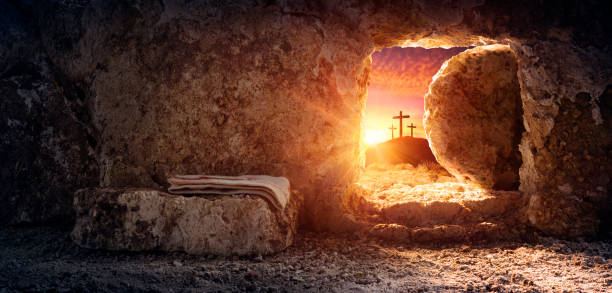
Easter is the day the Community of the Redeemed have been released from the power and chains of sin and the fear of death. Our spiritual forefathers in the first century saw this day of spiritual independence so important that they did not designate one day a year to celebrate. Rather, they began the practice of gathering the first day of every week (Sunday) to celebrate Easter. They celebrated the death, burial and resurrection of our Lord Jesus Christ. It was called the Lord’s Day (Acts 20:7; 1 Cor. 16:2; Mark 16:9,12,14; Luke 24:13-35). The Jews worshipped on Saturday (the Sabbath), but the “Church” quickly began worshipping the first day of every week (Sunday).
As we approach the 4th of July, it is appropriate to cheer and celebrate our nations Independence Day and the good things in our country while at the same time not dismissing where we need to be better. But, we must never practice syncretism by mixing the two Independence days. The Lord’s day was designed to celebrate our Spiritual Independence Day. When we gather for Sunday worship, we gather to lift up our Savior, and never to lift up our human-made nation. For our nation at times has been used by God, and at other times it has been used by Satan. On Sunday there is only one sacrifice that we lift up, one allegiance that we bow before, one Savior that we sing to and serve.
John Adams acknowledged the 1776 vote of independence was an act of God and therefore, it requires an act of devotion, thankful for our Almighty God’s intervention. But for the Church, the Community of the Redeemed, every day requires an act of devotion to our God no matter what nation we originate from. For it is our spiritual Independence Day that provides hope for the future and the true freedom for the human spirit!
July 3, 2024 by Dirke Johnson

Dirke Johnson has a doctorate in Church Leadership and is a professor for the Ministry Degree program at Palm Beach Atlantic University. He works with Cru’s Global Theological Development as part of the Int’l Leadership Consortium. He specializes in Leader Development, creating high performing teams. He has years of experience at ministering in urban cross- cultural and international contexts.
 Dirke & Lorna Johnson